
cardio-met
@cardiomet_CE
1) Welcome to a new #accredited #tweetorial and an update on #ATTR_CM examining the most interesting & important data published in 2Q 2026! We welcome back expert faculty Han Naung Tun (aka Henry Han) MD @HanCardiomd, #cardiologist Physician-Sci & Researcher #HeartFailure

Jul 7, 2026View on X ↗
cardio-met
@cardiomet_CE
2a) This program is intended for #HCPs and is supported by an independent grant from BridgeBio. You can earn a full 1 hr of 🆓CE/#CME credit by following this 🧵!
#cardioX #cardioTwitter #MedEd #ATTRCM #ATTRCMAwareness #KnowATTRCM #ATTRAmyloidosis #CardiacAmyloidosis
#cardioX #cardioTwitter #MedEd #ATTRCM #ATTRCMAwareness #KnowATTRCM #ATTRAmyloidosis #CardiacAmyloidosis
Jul 7, 2026View on X ↗
cardio-met
@cardiomet_CE
2b) Faculty disclosures & statement of accreditation are at cardiometabolic-ce.com/disclosures/. Follow us for the best in #cardiometabolic #MedEd, always by expert faculty, always for 🆓credit!
🔗 cardiometabolic-ce.com
🔗 cardiometabolic-ce.com
Jul 7, 2026View on X ↗
cardio-met
@cardiomet_CE
3) #ATTR is a rapidly evolving disease with rising prevalence and improving prognosis.
📍 Disease progression in ATTR-CM should be assessed using a multimodal, globally applicable approach.
📍 Disease progression in ATTR-CM should be assessed using a multimodal, globally applicable approach.
Jul 7, 2026View on X ↗
cardio-met
@cardiomet_CE
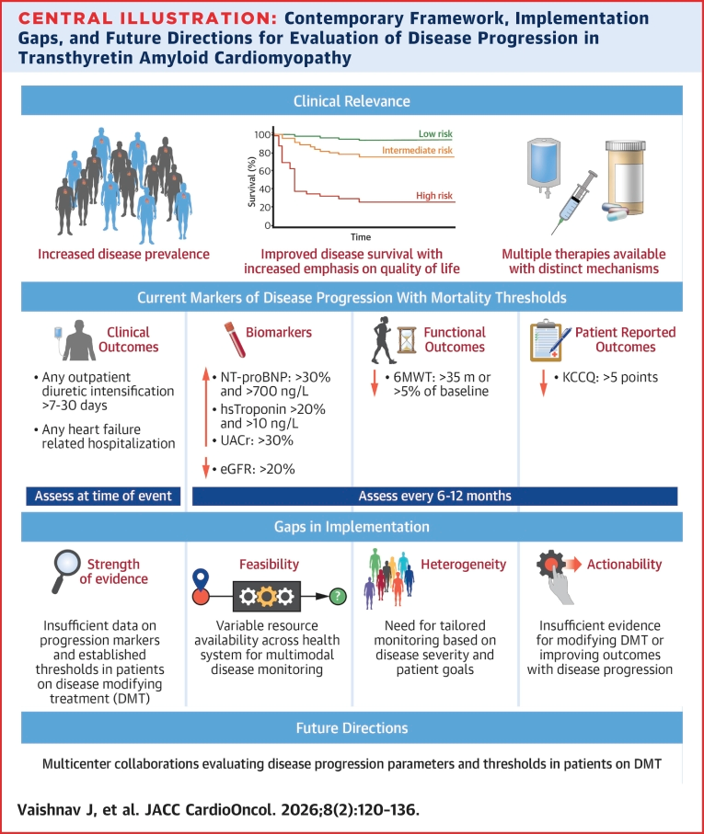
4a) @jvaishnavmd et al in #JACC #CardioOncol highlight current approaches & future directions in disease monitoring for #ATTR . . .
Jul 7, 2026View on X ↗
cardio-met
@cardiomet_CE
4b) emphasizing the need for further investigation of neurologic & other non-🫀 indicators of disease prog, alongside ongoing refinement of multimodal monitoring strategies. See 🔓 pubmed.ncbi.nlm.nih.gov/42017563/
Jul 7, 2026View on X ↗
cardio-met
@cardiomet_CE
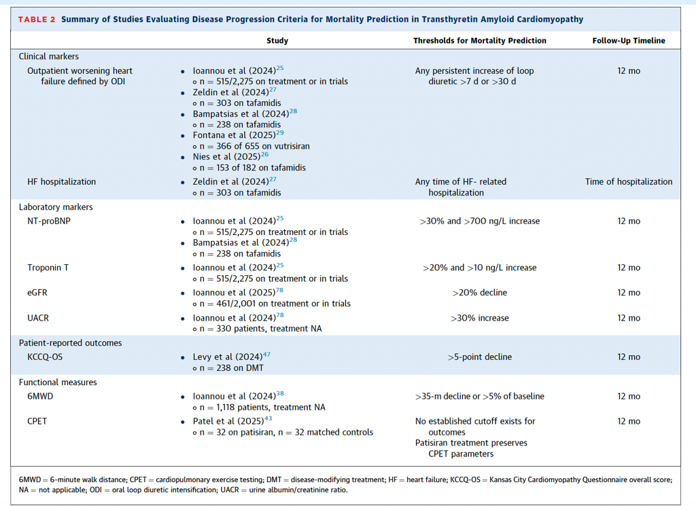
5) How should disease progression criteria in #ATTR_CM be adapted for patients on current disease-modifying therapies #DMT?
Though 2021 expert consensus defined multi-domain progression markers, most were derived from pre-DMT cohorts, limiting applicability to treated patients.
Though 2021 expert consensus defined multi-domain progression markers, most were derived from pre-DMT cohorts, limiting applicability to treated patients.
Jul 7, 2026View on X ↗
cardio-met
@cardiomet_CE
6a) There is growing interest in how modulation of transthyretin #TTR levels translates into clinical benefit in #ATTRCM
📍ATTR-CM leads to #HF & is associated with ⬇️ survival
📍 Low serum transthyretin #sTTR levels are frequently observed and may reflect disease severity
📍ATTR-CM leads to #HF & is associated with ⬇️ survival
📍 Low serum transthyretin #sTTR levels are frequently observed and may reflect disease severity
Jul 7, 2026View on X ↗
cardio-met
@cardiomet_CE
6b) #Acoramidis is a #TTR #stabilizer. How is acoramidis-related early change from baseline in serum transthyretin (ΔsTTR) associated with #cardiovascular-specific outcomes in ATTR-CM? Ambardekar et al eval’d this in a new analysis from #ATTRibute_CM
🔓pubmed.ncbi.nlm.nih.gov/42128580/.
🔓pubmed.ncbi.nlm.nih.gov/42128580/.
Jul 7, 2026View on X ↗
cardio-met
@cardiomet_CE
6c) What do you think they found? Which of these best describes the effect of #acoramidis on #CVM or first #CVH at 30 months?
A) No significant difference vs placebo
B) ~20% #RRR
C) ~38% RRR with early separation of curves
D) ~60% RRR but delayed benefit
A) No significant difference vs placebo
B) ~20% #RRR
C) ~38% RRR with early separation of curves
D) ~60% RRR but delayed benefit
Jul 7, 2026View on X ↗
cardio-met
@cardiomet_CE
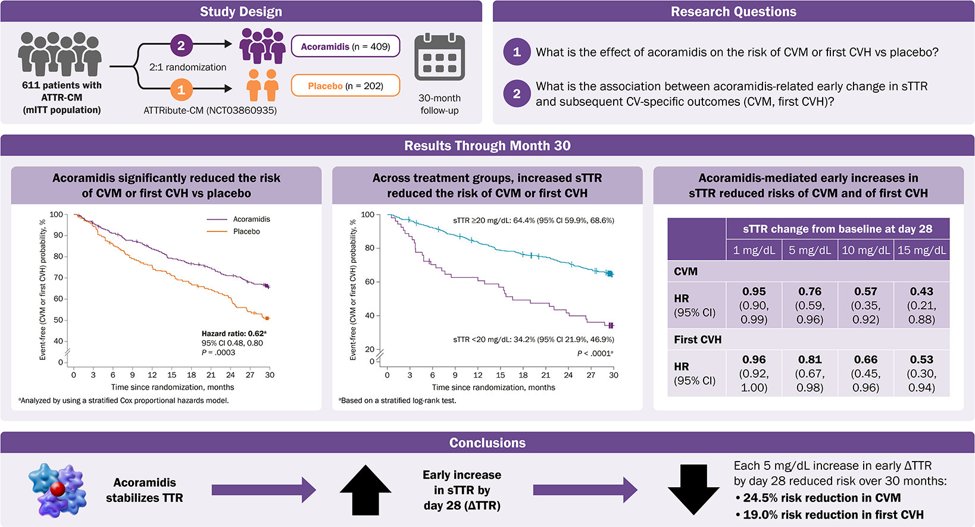
6d) The trial showed:
🫀 HR 0.62 → corresponds to ~38% RRR, with
🫀 Kaplan–Meier curves separated as early as month 3, and
🫀 Continued divergence through 30mos
🫀 There was a significant reduction in #CVM or first #CVH vs placebo
🫀 HR 0.62 → corresponds to ~38% RRR, with
🫀 Kaplan–Meier curves separated as early as month 3, and
🫀 Continued divergence through 30mos
🫀 There was a significant reduction in #CVM or first #CVH vs placebo
Jul 7, 2026View on X ↗
cardio-met
@cardiomet_CE
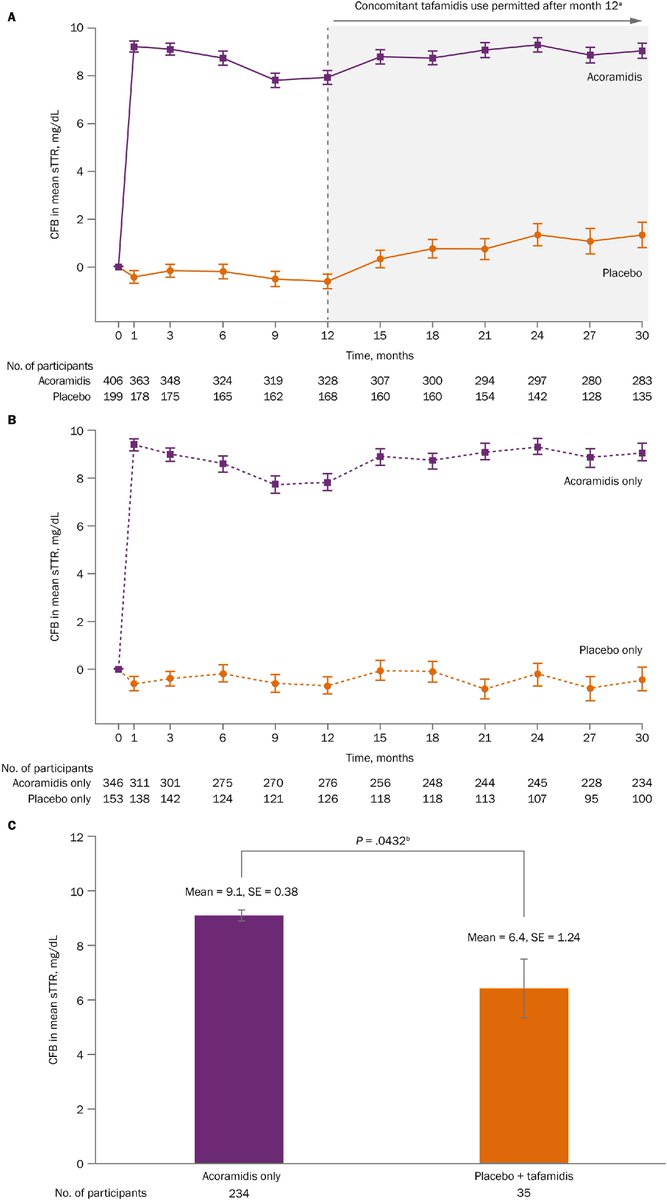
7a) Further, #acoramidis treatment ➡️rapid & sustained ⬆️in #sTTR: by Day 28, sTTR ⬆️~9.2 mg/dL (SE 0.25) & remained elevated thru month 30: durable pharmacodynamic effect.
Vs placebo: minimal change D28 & remained largely unchanged thru M30, w/only slight late ⬆️after M12.
Vs placebo: minimal change D28 & remained largely unchanged thru M30, w/only slight late ⬆️after M12.
Jul 7, 2026View on X ↗
cardio-met
@cardiomet_CE
7b) Importantly, higher & sustained #sTTR levels were associated with: 🫀improved clinical outcomes 🫀pharmacologic stabilization to disease progression & CV events in #ATTR-CM.
What else can we say about #TTR stabilization, changes in #sTTR, & clinical outcomes in #ATTR_CM?
What else can we say about #TTR stabilization, changes in #sTTR, & clinical outcomes in #ATTR_CM?
Jul 7, 2026View on X ↗
cardio-met
@cardiomet_CE
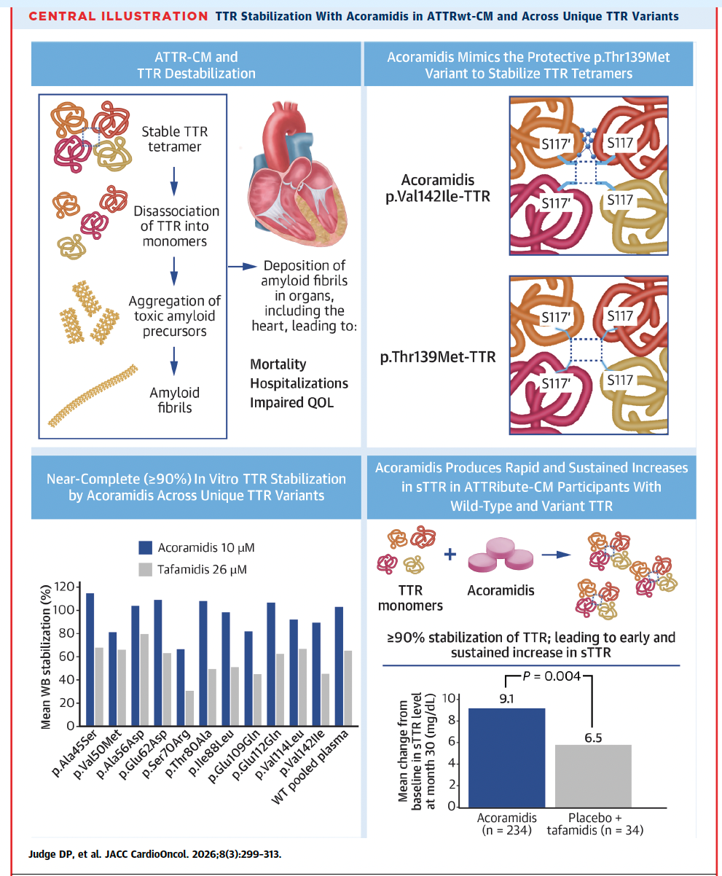
8a) Daniel Judge et al recently reported interesting findings on #TTR stabilization with #acoramidis in #ATTRwt_CM and across diverse TTR variants.
See 🔓jacc.org/doi/10.1016/j.…
See 🔓jacc.org/doi/10.1016/j.…
Jul 7, 2026View on X ↗
cardio-met
@cardiomet_CE
8b) How do u 🔬 #ATTRibute-CM data re effects of #acoramidis vs #tafamidis on #sTTR levels & TTR stabilization?
A) Tafamidis ➡️ higher sTTR ⬆️vs acor
B) Acoramidis ➡️greater sTTR ⬆️ & ~90% TTR stab, w/ or w/o taf
C) Pbo ➡️highest TTR stab
D) No diff in sTTR/stab across groups
A) Tafamidis ➡️ higher sTTR ⬆️vs acor
B) Acoramidis ➡️greater sTTR ⬆️ & ~90% TTR stab, w/ or w/o taf
C) Pbo ➡️highest TTR stab
D) No diff in sTTR/stab across groups
Jul 7, 2026View on X ↗
cardio-met
@cardiomet_CE
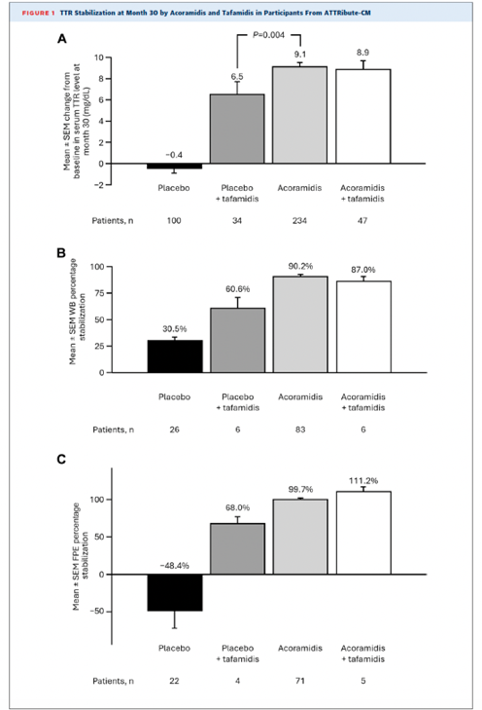
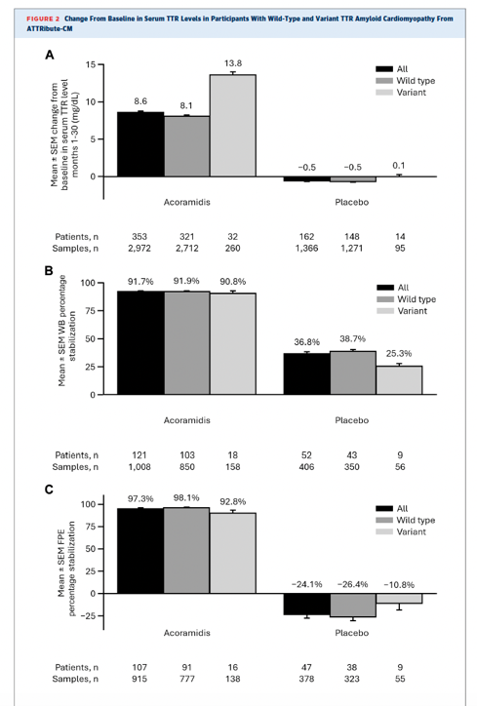
8c) In this analysis of #ATTRibute_CM (pubmed.ncbi.nlm.nih.gov/38197816/), at 0 mo + pooled 1–30mo:
🎯#Acoramidis ⬆️#sTTR vs placebo (9.1 ± 0.4 vs −0.4 ± 0.5 mg/dL); placebo→ #tafamidis: 6.5 ± 1.3 mg/dL (p=0.004)
🎯 Effect persisted with add-on tafamidis (≈8.9 ± 0.8 mg/dL)
(cont)
🎯#Acoramidis ⬆️#sTTR vs placebo (9.1 ± 0.4 vs −0.4 ± 0.5 mg/dL); placebo→ #tafamidis: 6.5 ± 1.3 mg/dL (p=0.004)
🎯 Effect persisted with add-on tafamidis (≈8.9 ± 0.8 mg/dL)
(cont)
Jul 7, 2026View on X ↗
cardio-met
@cardiomet_CE
8d (cont)
🎯Highest #TTR stabilization w/#acoramidis (~90% WB; ~100% FPE), maintained w/w/out tafamidis
🎯 Pooled analysis: #ATTRwt-CM ΔsTTR +8.1 vs −0.5 mg/dL (placebo); consistent benefit across #ATTRv-CM
🎯 WB stabilization: ~92% acor vs ~39% (PBO); FPE: ~97% vs ~−24%
🎯Highest #TTR stabilization w/#acoramidis (~90% WB; ~100% FPE), maintained w/w/out tafamidis
🎯 Pooled analysis: #ATTRwt-CM ΔsTTR +8.1 vs −0.5 mg/dL (placebo); consistent benefit across #ATTRv-CM
🎯 WB stabilization: ~92% acor vs ~39% (PBO); FPE: ~97% vs ~−24%
Jul 7, 2026View on X ↗
cardio-met
@cardiomet_CE
8e) So what did we learn?
🫀 Guide tx decisions in ATTR-CM by clinical trial evidence; now multiple safe/effective #DMTs are available
🫀 H2H #acoramidis v #tafamidis #CVOT would be 🎇, but unlikely to occur; mechanistic studies ⚖️ #TTR stab may further inform tx selection
🫀 Guide tx decisions in ATTR-CM by clinical trial evidence; now multiple safe/effective #DMTs are available
🫀 H2H #acoramidis v #tafamidis #CVOT would be 🎇, but unlikely to occur; mechanistic studies ⚖️ #TTR stab may further inform tx selection
Jul 7, 2026View on X ↗
cardio-met
@cardiomet_CE
9a) Exploring further the evidence for #TTR stabilization in ATTR-CM: Are there data supporting the efficacy of #acoramidis beyond the global #ATTRibute-CM trial in the Asian population? Now there are, thanks to Nobuhiro Tahara et al, in 🔓 pubmed.ncbi.nlm.nih.gov/42110872/
Jul 7, 2026View on X ↗
cardio-met
@cardiomet_CE
9b) Here we saw a propensity score comparison between a Japanese Phase 3 open-label study and the global Phase 3 #ATTRibute-CM trial, ➡️ additional insights into the effectiveness of #acoramidis across diverse patient populations.

Jul 7, 2026View on X ↗
cardio-met
@cardiomet_CE
9c) So which outcome was observed w/#acoramidis vs propensity score–matched placebo over 30mo in this🗾 analysis ?
A) No diff in survival or functional status
B) Higher hosp rates but improved #QoL
C) ⬇️ #ACM/#CV events, CV hosp, & decline in #6MWD & #KCCQ_OS
D) ⬆️ 6MWD only
A) No diff in survival or functional status
B) Higher hosp rates but improved #QoL
C) ⬇️ #ACM/#CV events, CV hosp, & decline in #6MWD & #KCCQ_OS
D) ⬆️ 6MWD only
Jul 7, 2026View on X ↗
cardio-met
@cardiomet_CE
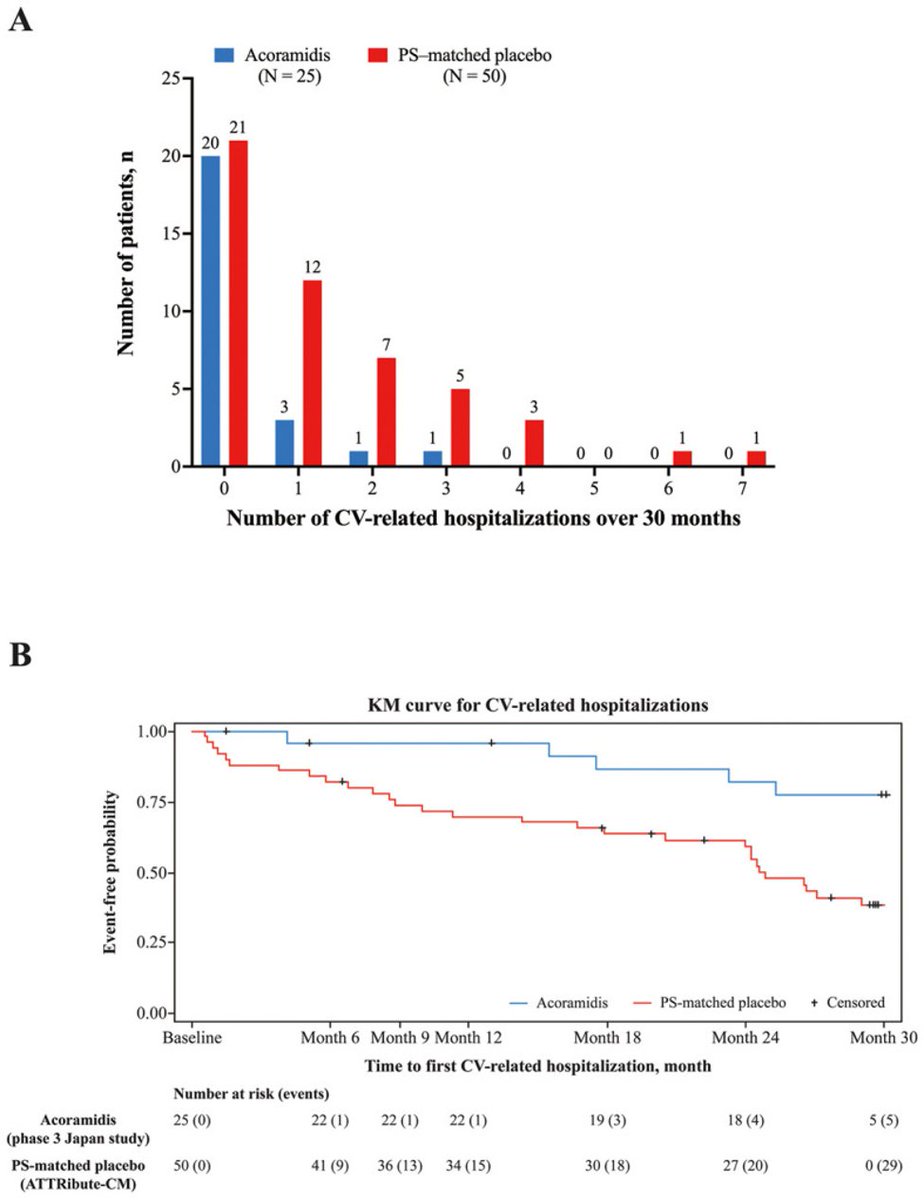
9d) The 🔑findings in pubmed.ncbi.nlm.nih.gov/42110872/were:
🎯 92% ⬇️in #ACM (HR 0.08; P=0.006)
🎯Survival at 30mo: 100% vs 76%
🎯 ⬇️annualized #CV hospitalizations: 0.13 vs 0.83/patient
🎯 Less ⬇️in #6MWD (−36 vs −103 m)
🎯 Less ⬇️ in #KCCQ_OS (−7 vs −27)
🎯 92% ⬇️in #ACM (HR 0.08; P=0.006)
🎯Survival at 30mo: 100% vs 76%
🎯 ⬇️annualized #CV hospitalizations: 0.13 vs 0.83/patient
🎯 Less ⬇️in #6MWD (−36 vs −103 m)
🎯 Less ⬇️ in #KCCQ_OS (−7 vs −27)



Jul 7, 2026View on X ↗
cardio-met
@cardiomet_CE
9e) #Efficacy/#safety of #acoramidis in Japanese adults with symptomatic #ATTRCM ?
✅No deaths reported, low CVH rate, minimal ⬇️ in 6MWD at 12mo, sustained ⬆️ #sTTR levels & near-complete TTR stab (median 95.6%)
✅ Well tolerated w/favorable safety profile
#CardioTwitter
✅No deaths reported, low CVH rate, minimal ⬇️ in 6MWD at 12mo, sustained ⬆️ #sTTR levels & near-complete TTR stab (median 95.6%)
✅ Well tolerated w/favorable safety profile
#CardioTwitter

Jul 7, 2026View on X ↗
cardio-met
@cardiomet_CE
10) So what have we learned?
✅ #Acoramidis achieves near-complete (~90%) #TTR stabilization + sustained clinical benefit thru 30mos w/ continued gains through 42mos.
❓What do we need to know?
🔍 The long-term durability of these benefits beyond 42mos
#ATTRCM
✅ #Acoramidis achieves near-complete (~90%) #TTR stabilization + sustained clinical benefit thru 30mos w/ continued gains through 42mos.
❓What do we need to know?
🔍 The long-term durability of these benefits beyond 42mos
#ATTRCM
Jul 7, 2026View on X ↗
cardio-met
@cardiomet_CE
11a) Now, as John Oliver likes to say, “moving on”:
Which outcome domains are most important for assessing long-term durability of tx in #ATTR_CM?
A) Survival only
B) #Biomarkers only
C) Survival, biomarkers, functional capacity, & #QoL
D) Imaging findings alone
Which outcome domains are most important for assessing long-term durability of tx in #ATTR_CM?
A) Survival only
B) #Biomarkers only
C) Survival, biomarkers, functional capacity, & #QoL
D) Imaging findings alone
Jul 7, 2026View on X ↗
cardio-met
@cardiomet_CE
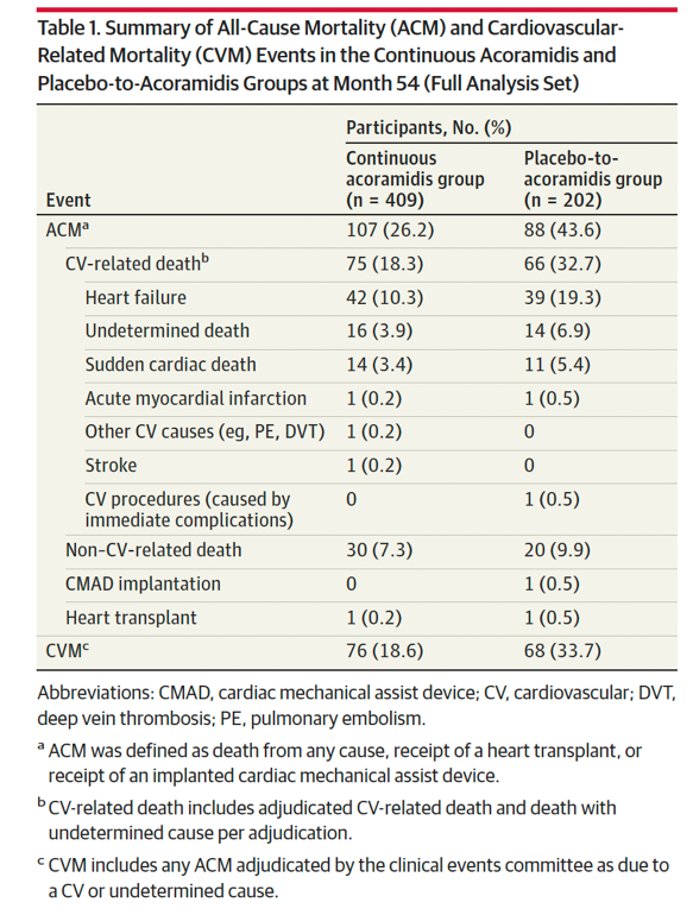
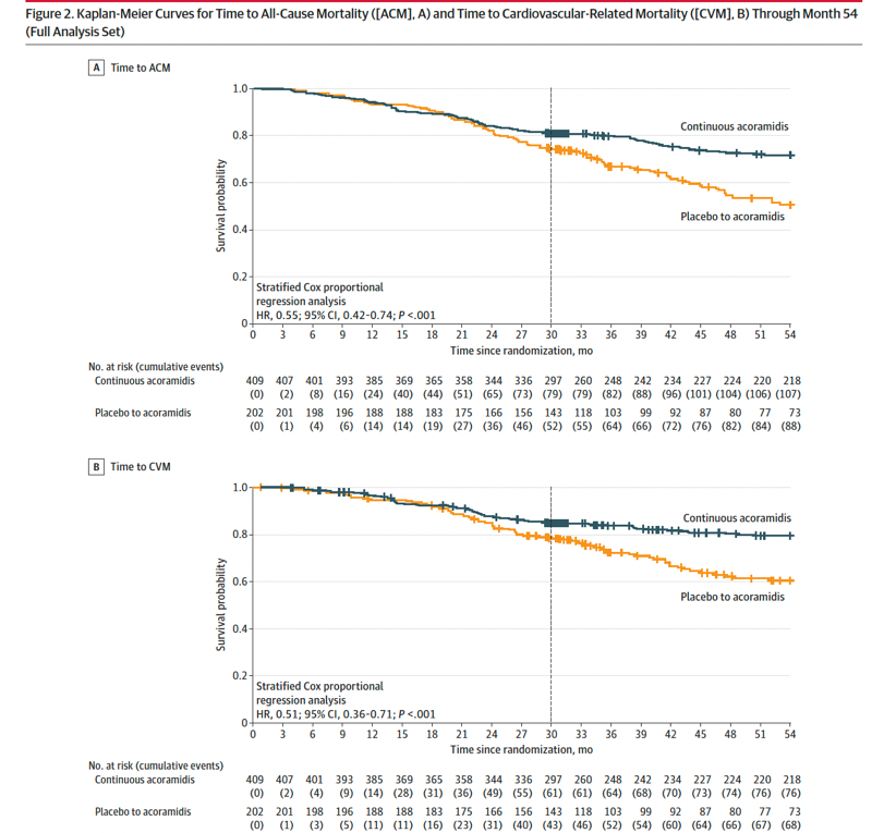
11b) In 2Q2026 pubs we find @premsoman123‘s data thru 54mos for #TTR #stabilizer #acoramidis in #ATTRCM:
🫀 Continuous acoramidis ⬇️ #ACM by 45% vs placebo→acor (HR 0.55; P<0.001), 43.6% ➡️26.2%
🫀 #CVM ⬇️ by 49% (HR 0.51; P<0.001), 33.7% ➡️18.6%
🔓pubmed.ncbi.nlm.nih.gov/41911489/
🫀 Continuous acoramidis ⬇️ #ACM by 45% vs placebo→acor (HR 0.55; P<0.001), 43.6% ➡️26.2%
🫀 #CVM ⬇️ by 49% (HR 0.51; P<0.001), 33.7% ➡️18.6%
🔓pubmed.ncbi.nlm.nih.gov/41911489/
Jul 7, 2026View on X ↗
cardio-met
@cardiomet_CE
11c) These data from #ATTRibute-CM #OLE: at 54mos #acoramidis showed
📍⬇️1st #CVH by 47%
📍Sustained benefits: #NTproBNP #sTTR #KCCQ_OS #6MWD
📍 Pts switched from Pbo also ➡️clinical stabilization
📍 🚫 new long-term safety concerns
📌Durable efficacy/safety thru 54mos
📍⬇️1st #CVH by 47%
📍Sustained benefits: #NTproBNP #sTTR #KCCQ_OS #6MWD
📍 Pts switched from Pbo also ➡️clinical stabilization
📍 🚫 new long-term safety concerns
📌Durable efficacy/safety thru 54mos


Jul 7, 2026View on X ↗
cardio-met
@cardiomet_CE
12a) Re prognostic value of 🧪#sTTR levels: In a new #ATTRibute_CM analysis of 557 pts tx’d w/#acoramidis, an ⬆️ in sTTR levels of +5 mg/dL was assoc’d w/which outcome thru 30mos?
A. 10% ⬆️risk of hosp
B. No change in mortality
C. 31.6% ⬇️odds of #ACM
D. 50% ⬇️ arrhythmia burden
A. 10% ⬆️risk of hosp
B. No change in mortality
C. 31.6% ⬇️odds of #ACM
D. 50% ⬇️ arrhythmia burden
Jul 7, 2026View on X ↗
cardio-met
@cardiomet_CE
12b) Podcast by @MathewMaurer & Adam Castaño 🔓pubmed.ncbi.nlm.nih.gov/41925133/
📌 #sTTR reflects pharm stabilization of #ATTRCM
📌#Acoramidis ⬆️sTTR early, durably in ATTRibute-CM
📌 Each +5 mg/dL ⬆️ sTTR 🔗to 31.6% ⬇️mortality odds @ 30mos
📌 sTTR is potential prognostic biomarker
📌 #sTTR reflects pharm stabilization of #ATTRCM
📌#Acoramidis ⬆️sTTR early, durably in ATTRibute-CM
📌 Each +5 mg/dL ⬆️ sTTR 🔗to 31.6% ⬇️mortality odds @ 30mos
📌 sTTR is potential prognostic biomarker


Jul 7, 2026View on X ↗
cardio-met
@cardiomet_CE
@MathewMaurer 13a) We also have 🧬 emerging evidence: 🔓 doi.org/10.1080/135061… suggests #TTR stabilizer therapy may do MORE than stabilize transthyretin.
In #ATTR-CM, naturally occurring anti-TTR Ab ⬆️ by ~22% w/TTR-stabilizing therapy & were shown to ⬇️ TTR fibril aggregation in vitro.
In #ATTR-CM, naturally occurring anti-TTR Ab ⬆️ by ~22% w/TTR-stabilizing therapy & were shown to ⬇️ TTR fibril aggregation in vitro.
Jul 7, 2026View on X ↗
cardio-met
@cardiomet_CE
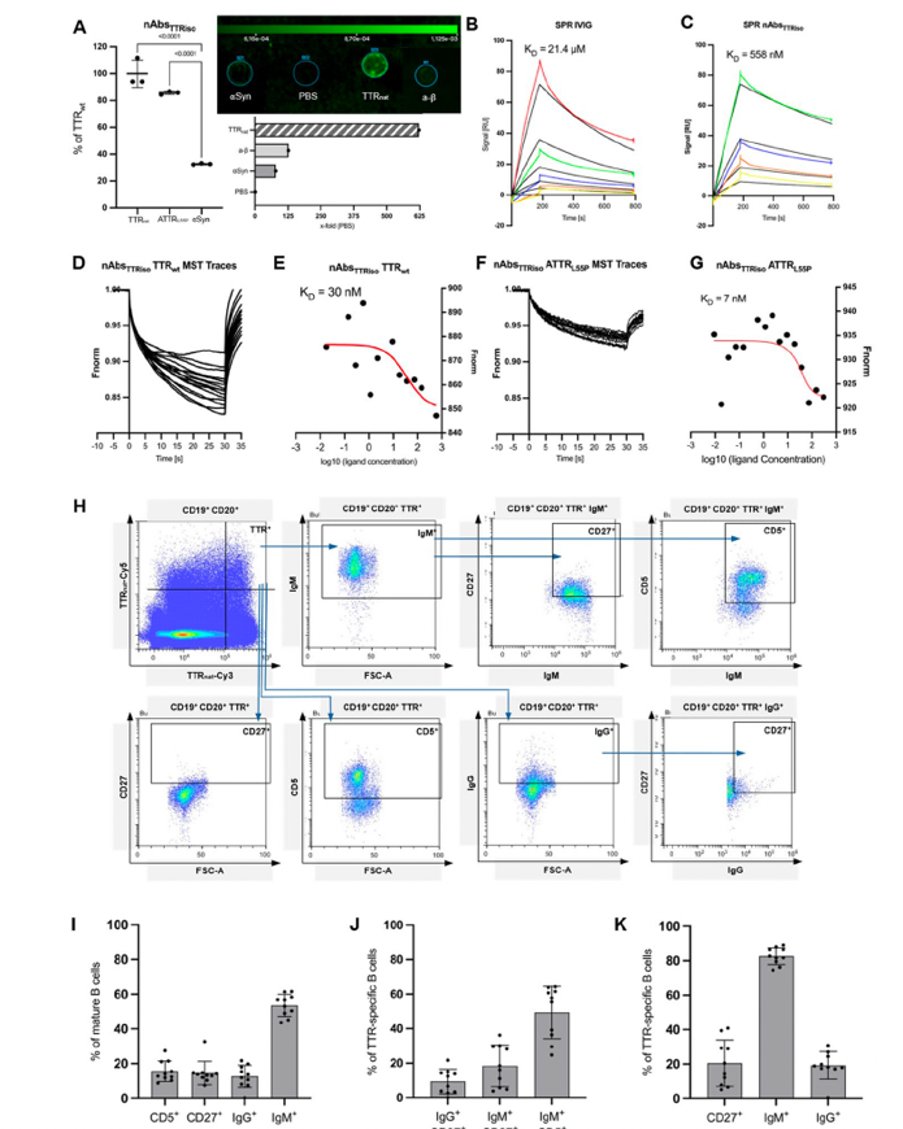
@MathewMaurer 13b) 🤔Could an immune modulation mechanism add to direct effects of #TTR stabilizers?
🧪These data show that nAbsTTR exhibit selective binding to #TTR (wt & variants) vs #amyloid controls
📍confirmed w/ ELISA, SPR, & MST
📍high affinity, minimal off-🎯binding
🧪These data show that nAbsTTR exhibit selective binding to #TTR (wt & variants) vs #amyloid controls
📍confirmed w/ ELISA, SPR, & MST
📍high affinity, minimal off-🎯binding

Jul 7, 2026View on X ↗
Claim your 1.0hr CE/CME credit
Free · MD, RN, and PharmD — the post-test form appears here on the live page